
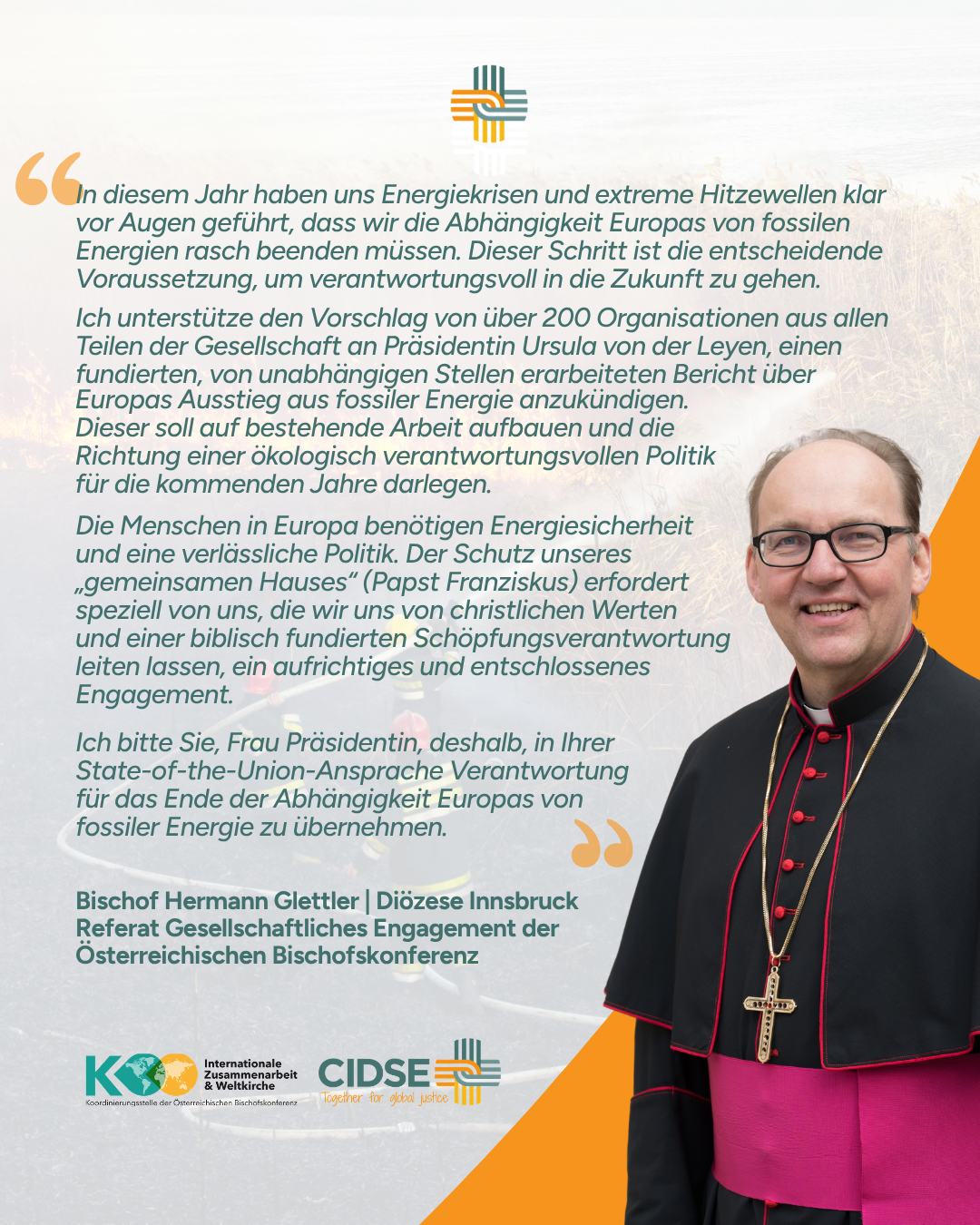
Bischof Glettler und KOO fordern Ausstieg aus fossiler Energie von EU-Kommissionspräsidentin
Die Koordinierungsstelle unterstützt im Vorfeld der State of the European Union Rede von EU-Kommissionspräsidentin Ursula von der Leyen einen Aufruf von über 200 Organisationen sowie Branchenverbänden für ein Ende der fossilen Energie in der EU, damit diese Krise der fossilen Abhängigkeit die letzte ihrer Art in Europa bleibt. Wir fordern von Ursula von der Leyen einen unabhängigen Bericht – analog zu den Draghi und Letta Berichten – welcher Europas Ausstieg aus fossiler Energie darlegt, auf die bereits bestehende Arbeit der EU aufbaut und die Richtung einer ökologisch verantwortungsvollen Politik für die kommenden Jahre vorgibt. Umweltbischof Glettler unterstützt dieses Anliegen mit einer persönlichen Botschaft an die Kommissionspräsidentin.
Der Brief vom 24. August 2026 im Originaltext und hier zum Nachlesen
Subject: Making this fossil fuel crisis Europe’s last
Dear President von der Leyen,
Your State of the European Union address comes at a defining moment.
This summer, Europeans are paying twice for the EU’s continued dependence on fossil fuels. First, in higher energy costs: the second fossil fuel crisis in just four years has added more than €50 billion to Europe’s energy bill for households and businesses. Second, in the human and economic toll of the climate crisis: successive heatwaves since May have brought record temperatures, devastating wildfires and severe droughts across the continent, with the June heatwave alone estimated to claim at least 14,000 lives in Europe.
None of this is accidental. Fossil fuel dependence has repeatedly undermined Europe’s prosperity and constrained its ability to act in the world. As long as Europe relies on fossil fuels, its citizens remain exposed to price shocks and geopolitical decisions made elsewhere. That exposure is a choice, and Europe can choose differently.
To chart the future of the single market and Europe’s competitiveness, you commissioned landmark independent reports that propelled these issues to the top of the EU’s agenda. Europe’s independence from fossil energy now requires the same ambition.
We therefore urge you to use your upcoming address to announce the launch of a comprehensive, science-based and independent report with one clear objective: to make this fossil fuel crisis Europe’s last.
Led by an eminent independent figure and developed with academia, civil society, social partners and businesses, this report should provide a shared strategic vision for the remainder of the mandate, and deliver a fossil fuel exit plan based on five priorities:
1. Quantify the full economic and financial burden of dependence: put a number on what fossil fuels drain each year from households, industry and public budgets, including import bills, exposure to price shocks, health and environmental impacts as well as climate damages.
2. Chart the fastest competitive exit: identify, sector by sector, where fossil fuel vulnerabilities are most acute and set out a pathway to a complete phase-out built on the most cost-effective proven solutions — renewables, energy efficiency, circular economy solutions, modern grids and clean flexibility — with secure supply chains for the critical materials European industry depends on. The pathway must not rest on overhyped and unproven technologies that risk delaying the transition and damage the ecosystems we depend on.
3. Align every euro with the exit: identify where EU and national finance, subsidies and spending still prolong dependence, and recommend how to align them with the phase-out.
4. Leave no one behind: identify the governance and financial support needed to deliver a truly just transition, ensuring vulnerable households, workers, companies and affected regions are supported. Worker organisations should be at the centre of its design.
5. Make nature our ally and first line of defence in climate action: set out how to unlock investments, at scale, in natural solutions that Europe already knows work — forests, wetlands and soils that absorb carbon, floodplains that absorb floods, green spaces that cool cities, all at a fraction of the costs of engineered alternatives. Identify what keeps these solutions underfunded despite the evidence whilst disregarding the ones that pose a risk to nature.
By commissioning this report in your State of the Union address and committing to act on its findings with the urgency the situation demands, you can make this crisis a turning point, and give Europeans an energy system that works for them: affordable, renewable, secure and homegrown.
Yours sincerely,
Co-ordination Office of the Austrian Bishops' Conference for International Cooperation and Global Church and 200+ European, international and national organisations and industry associations